Life After the Grid
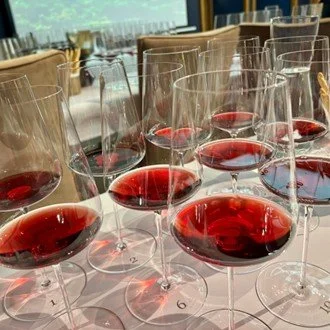
In a tasting workshop led by a Master of Wine last night, I realized something quietly but unmistakably. Before I even started my grid, before I started naming aromas, assessing structure or mentally searching for evidence of complexity, I already knew how I felt about the wine: I didn’t like it.
Not because it was faulty, or thin, or poorly made. It was aromatically expressive, textbook correct, even well made. A regional commodity wine, executed exactly as intended. And yet, there was nothing pleasant about it. It asked nothing of me. It wasn’t flawed or dead. It simply didn’t move me, challenge me, or linger in any meaningful way.
The unsettling part wasn’t my reaction. It was realizing that the grid had no language for it.
The shift
The grid has been my longtime partner in wine studies for good reason: it taught me how to look. It trained my attention. It helped me shape my language and arguments and holds up under pressure (mad props to my CMS friends— I don’t know how you analyze and conclude while keeping everything in your head). Description obviously comes first because you can’t understand a wine until you have learned to see it clearly.
But I’ve noticed a subtle shift lately. When I’m not freaking out in a mock exam, I tend to notice the wine’s personality before its components: its texture, its energy. It’s as if I register the wine’s coherence, or lack of it, before I’m able to justify it analytically.
Description still matters. Lord knows I need the language, the evidence, and the discipline, but it no longer feels like the starting point.
Understanding is.
Going off the grid
The grid has always been a tool of reduction. To learn something as complex as wine, it helps to break it down into parts that can be named, compared, and evaluated consistently.
But reduction has its limits. At a certain point, breaking the wine apart starts to obscure the very thing you’re trying to understand.
And here’s the part I’ve been embarrassingly slow to recognize: I’ve used the grid not just as a training tool, but as a shield. It’s far safer to catalog than to encounter. Reductionism can become a way of avoiding embodiment, of staying in analysis instead of presence, especially in professional contexts where defensibility matters.
The grid was never meant to disappear, but it was never meant to be a destination either. Its job is to train perception until perception no longer needs prompting. The challenge I’m grappling with now isn’t choosing between reduction and embodiment: it’s knowing when to move from one to the other…and having the discipline to do both.
Now what?
What I don’t have yet is a replacement. And I’m not completely convinced that I should.
The unresolved question for me is how we train both memory and embodiment, and how we keep them in a proper balance. The grid is excellent for building recall. It gives the mind something to hold on to under pressure. But embodiment seems to require a different kind of practice: slower, quieter, less directive.
My instinct is to swap one grid with another and convince myself that new vocabulary equals progress. But is it? Presence doesn’t seem to respond well to instruction in the same way memory does.
So the grid still exists in my world, but I’m experimenting with paying attention to what registers before I reach for language. Whether that kind of presence can be trained deliberately, I don’t yet know. For now, I’m paying more attention to the order in which understanding arrives. And I’m trying (trying!) not to rush to close the question too quickly.
Evolution
Some wines still benefit from being taken apart carefully. Others reveal themselves more clearly when I resist the urge to intervene too quickly. I’m learning to distinguish the two.
Something has shifted in how I experience the glass in front of me. I’m learning to loosen my grip.
And I’m starting to trust that understanding, when it arrives, doesn’t always announce itself in tidy terms.